Thursday, June 30, 2011

Great Rant About Processed Meat #paleo

450px-flickr_spine_472065553--

Melissa from Hunt.Gather.Love has a great rant about the fallacy that eating meat makes you overeat. IT'S NOT THE MEAT, STUPID. It's all of the crap that's added to the meat to make it palatable and easy to chew. By the time you salt it, bread it, enhance it with a solution of sodium nitrate and heaven-knows-what-else so you can deep-fry it in soybean oil, you could have started with tofu, and people would still overeat the stuff.

Wednesday, June 29, 2011

Summer Activities for Paleos #paleo

Many people consider paleo or primal living to be a lifestyle, not just a diet. Mark's Daily Apple has some great ideas for passing the time this summer while simultaneously reconnecting with nature.

via Mark's Daily Apple by Mark Sisson on 6/28/11

fishcampfireThere’s nothing like living Primal in summer. Certain aspects just come easier: the copious fresh produce, unlimited outdoor exercise, long daylight, ample sunshine. True, those of us in the warmer states have some year-long advantage here. Nonetheless, summer remains my favorite season – probably a result of my New England roots. The brevity of the season there inevitably inspires a true carpe diem attitude. Wherever you go, however, I think summer brings with it a sense of adventure and spontaneity. Even if our school years are (decades) long gone, we still embrace summer as a kind of “holiday” from the routine. For many of us, the season is a time to explore, travel, and live outside, relegating the house to role of mere storage unit. There are the elaborate vacations, the well-planned day trips, the sporting and social events. Today, however, I’m thinking along nostalgic lines, some old school pastimes that invoke the (somewhat endangered) ease of summer.

As a kid, my favorite summer days and evenings were all about playing rough, running free, and living like the young savage I was. Needless to say, by the end of the day, I was wearing and eating the elements. Here are a few of my favorites – little to no equipment or planning required. Some, you could say, have subtle survivalist elements. Others are just an afternoon’s adventure or an invitation to lose yourself in a few hours of outdoor daydreaming. (The PB is about enjoying the best of life after all.) Each of them in some way, I think, fit the Primal theme, and they’re family friendly to boot. Here’s to kicking it old school this summer. Enjoy, everyone!

Night Walk

I’ll just say it: we don’t appreciate the dark enough these days. Caught up in the world of 24-hour illumination, we’ve lost touch with how to live at night as our ancestors did. As Richard Louv noted in Last Child in the Woods, many urban children have never even been in darkness before. They represent and feel more dramatically what our society as a whole has gravitated toward in recent decades: a fear of and disowning of natural darkness.

On the nights when I got to stay out late, I relished wandering into the thick of the darkened woods. My heart would beat faster. My palms would sweat. I felt like an alert animal, excitedly crossing a mysterious threshold. Yet, within a few yards I was one with the shadows.

There’s a more practical Primal lesson to be absorbed as well. Many have written about the modern undeveloped sense of night vision. Paul Shepard, Peter Nabokov, and others explain that the peripheral vision (compliments of those handy rod cells) we inherently use to “see” our way through a dark trail accesses a primitive level of consciousness – the primal “unconscious” as it’s often called. We can see finally when we stop thinking, when we let these long-buried, primeval abilities take the reins. For a young child, this comes naturally. For the rest of us, it’s a skill and adventure worth rediscovering. Check out your local recreation and environmental chapters, which often host night walks or at least moonlit walks during the summer.

Creek Stomping

It’s not exactly “leave no trace,” I realize, but it doesn’t get much more raw or earthy than this. (Make a mud shirt while you’re at it.) You’ve got the sun, the mud, and the water. (What more does a kid/Primal type need?) Truth be told, it’s just walking through the water, but that never dampened our exuberance. You can easily burn an afternoon alternatively gliding and rushing through the water, stopping as often as you want to inspect something curious along the banks or to check out the wildlife crawling or swimming by you – if you haven’t scared them away. (Plus, there were always the fits of laughter after someone flipped out about a leech – or several – on their leg.) We did it barefoot when left to our own devices or in old sneakers at summer camp. Done stealthily, you can snag yourself a snack, which leads me to the next pastime….

Cooking Your Own Catch

No cooler or kitchen here. Try on the old school scouting endeavor of making a fire and cooking up – right there in the dirt and sticks – whatever you can hunt, catch, or gather (observing state laws of course). Those fish or crawdads you snagged creek stomping? How about cooking ‘em up beachside? Make your feast as recreational or survivalist as you want. No need for matches or a Bic. Go hunting for some kindling and good fire bow materials. Want a brush up on primitive fire building? Check out this article.

Tubing

First thing’s first: there’s absolutely no exercise or thought that goes into this endeavor. (Of course, that’s the point.) The more cerebral among us might enjoy studying the currents or taking advantage of bird watching opportunities. Mostly, though, tubing is the most soothing activity I’ve ever found. It’s literally impossible to be stressed while meandering down the river watching the trees, birds, and random wildlife/farm animals. (Cows especially love to watch tubers.) I’ll admit it’s been too long since my last go, but I recall the times I’ve tubed like they were yesterday. There are still a number of local tubing “societies” around the country that can hook you up with the best routes and get you happily acclimated into the summer tubing culture. (Although some like the solitary approach, others go in sizable groups with stocked floating coolers in tow.)

If you don’t have a tube worthy river by you (obviously not recommended for rivers with undertow or significant white water), use your tube to float on a nearby pond or small lake. No, you don’t get the benefit of constantly changing scenery around every bend, but it’s just as relaxing.

Stargazing

One of my favorite memories of camping when I was younger was sleeping on the beach of a small island where there was no light for miles around. Truth be told, I was too excited to sleep much that night. The sky was like a velvet backdrop dusted with millions of stars. Although there wasn’t a moon, the collective light of the stars was bright enough to light the beach and water. It was mid-August to boot, which meant we got to savor one of the best meteor showers of the year. I think we stopped counting shooting stars somewhere around 130.

There’s more to stargazing, of course, than shooting stars. How about mapping the constellations or learning to navigate by the stars like our primitive brethren?

Need a refresher on the constellations and the shifting night sky? Check out this PDF, for a summer night tour or Wunderground’s site, where you can get an exact map designed for your zip code.

Trail Running

I know a number of you out there do trail runs. Having abandoned my marathoning training years ago, this is the kind of running I most enjoy now (though, admittedly, it’s more walking than running these days). There’s something uniquely fortifying about the time on the trail that I just don’t get from a running path or even the beach for that matter. Of course, I often imagine myself running after or even with an imagined deer or other prey animal. With trail running, the key is becoming one with the trail as you allow yourself to “feel” it intuitively. As Peter Nabokov writes, certain indigenous groups have traditions of “trance running,” which grows from the runner’s relationship to the trail itself. The run becomes, in essence, a spiritual interaction between the earth and the runner him/herself. The trail isn’t to be learned but trusted. As a child it just inspired a kind of high, and today it does the same.

Early Dawn Climb

Years ago on a backpacking trip, we hiked our way to what would be our base camp in thick fog. As much of a PIA as it was at the time, the next morning’s view made it all worth it. We unknowingly woke up at the base of a majestic peak. We were all in total awe.

How about earning a similar moment of wonder without the overnight trek? Head out in the earliest light of dawn for what you know to be a rewarding trail. Although you’ll be making your way in dim light on the way up, you’ll enjoy your breakfast in the company of an incredible vista. Just think: you can still make that 8:00 a.m. meeting – although you’ll probably find yourself tempted to take the rest of the day off. Not a bad idea there.

Got your own old school summer exploits to share? (In my book, you can never have too many.) Comment away! Have a great week, everybody, and enjoy getting out there!

Get the Primal Blueprint Fitness eBook, Free Health Tips and Primal Recipes Delivered to Your Inbox

Related posts:

  1. Chilled Summer Soups
  2. Shrimp, Sausage and Summer Squash Casserole
  3. Summer Squash Noodles

Monday, June 27, 2011

Mark Sisson Weighs In on "Healthy" Vegetable Oils #paleo

Wondering about cold-pressed canola oil, camelina oil, or MCT oil and the paleo or primal diet? Here are some answers, courtesy of Mark's Daily Apple.

via Mark's Daily Apple by Mark Sisson on 6/26/11

oilToday’s Dear Mark roundup is a trio of oil-related questions. Learn about my adventures with MCT oil and whether it fits into a good eating plan. Hear about camelina, the “better flax.” And finally, we’ll go over whether fancy, cold-pressed canola oil is worth including or whether it’s still just canola oil.

I’m thinking I’ll stick with this format for awhile. The response has been mostly positive, so why mess with what works? If ever a question arrives that merits a devoted full-length post, I’ll do that, but for now this seems like a hit.

What do you think of MCT oil?

Pam

MCTs, or medium chain triglycerides, are fatty acids that the body treats differently than longer chain fats. They are easily digested, head straight to the liver for oxidation or ketone generation without dealing with the lymphatic system, and can be utilized by cells for energy without the enzymatic processes needed to utilize longer chain fats. MCT oil is pure medium chain triglyceride. For this reason, it remains liquid at all temperatures despite being a highly saturated fat.

I’m not a huge fan of MCT oil, but not for any health reasons. I’ve just had weird experiences with it. I once used it to make mayo, since it’s flavorless, saturated, and stays liquid. It worked and the mayo tasted great, but it was just too big a bolus of MCTs at once. I used a couple tablespoons of MCT mayo with some hard boiled eggs and yellow mustard for egg salad, and a couple minutes after eating, I was infused with a weird, nervous energy. It felt similar to taking a quadruple shot of the strongest espresso on the planet sprinkled with a bit of Walter White’s special recipe, followed by a forced toilet trip. The fatty acids were being converted to pure energy – way more than my body needed at the time – and it wasn’t very pleasant. I tried it again as the base for a salad dressing, having run out of olive oil, and the effect was the same. It’s definitely not for me. I’ll stick to coconut oil for my MCT fix, since it never gives me any issues. While natural sources of MCTs, like coconut, contain the full range of MCTs (lauric acid, caproic acid, caprylic acid, and capric acid), most MCT oils are caprylic acid and capric acid. I suspect the isolation of the fatty acids is responsible for my problems with MCT oil.

That’s me, though. I don’t think there’s anything wrong with MCT oil, especially if you’re on a strict ketogenic diet or simply looking to get into ketosis (MCTs are the most ketogenic fatty acids), but I also think you could just eat coconut oil. I’ve heard of people who can’t handle coconut oil but for whom MCT oil works perfectly. Go figure. I’d suggest buying the smallest bottle of MCT oil you can find if you’re thinking of trying it. Here’s one not so small bottle.

Hi Mark,

Curious about Camelina oil – it is very high in Omega-3′s, has a high smoke point, tastes good on salads and in cooking.  I just want to know if it’s going to cause the same problems as other vegetable oils (which it is considered to be).

Thanks,

Mat

Camelina has been grown in Europe for at least 3,000 years as a food crop for livestock and for people, so at least it’s not some genetically modified, formerly toxic plant. It’s a seed, similar in some respects to flax, but with some important differences. Well, let’s explore a couple of the main problems with vegetable oils and see how camelina stacks up:

1. High in omega-6 – Vegetable oils have introduced a massive, evolutionarily-novel dose of linoleic acid into our diets, throwing off our dietary and tissue omega-3:omega-6 ratios and resulting in lopsided levels of eicosanoids derived from omega-6. More omega-6 eicosanoids mean our inflammation and response to stress are exaggerated. This is bad.

Camelina oil is similar to flax in that it’s high in alpha-linolenic-acid, the omega-3 fatty acid present in plants, and lower in omega-6 linoleic acid. Flax has an omega-3:omega-6 ratio of about 4:1, while camelina has a ratio ranging from 2:1 to 3:1. Put another way, camelina oil is between 35% and 45% ALA and between 15% and 20% linoleic acid. So, it has more omega-6 than butter, olive oil, macadamias, or beef fat, but similar levels as poultry and pork fat. It’s not a huge amount, but it can add up pretty quickly – especially if you’re aiming to keep omega-6 below five or six grams per day. And remember that it’s not just the ratio that matters, but the absolute amount of omega-6 in your diet.

2. Heat unstable, prone to oxidation inside and outside of the bodyPolyunsaturated fats are prone to oxidative damage when exposed to heat, air, and/or light. The PUFAs we eat are often incorporated into serum lipids, and LDL more easily oxidizes when it contains higher amounts of polyunsaturated fats (even omega-3s). This is bad.

By all accounts, camelina oil is considerably more heat-stable than flax oil. It contains high levels of antioxidants, including vitamin E (up to 110mg/100g, according to Wikipedia), which can protect against heat/light/air damage. However, antioxidants are only there because the fatty acids are so inherently unstable, so it’s not going to remain pure and untouched forever. Camelina oil must still be stored well (low temperature, secure lid, dark bottle) to prevent rancidity (PDF). And once it’s in your body, its ALA will be incorporated into your serum lipids in a disproportionate amount. While this study describes it as a positive thing, recall that LDL high in PUFAs has been shown to oxidize more easily. Perhaps camelina’s vitamin E will protect the LDL from oxidation, but I wouldn’t depend on it.

Overall, camelina oil seems a decent choice, at least compared to most vegetable oils. I wouldn’t cook with it, and I definitely wouldn’t use more than a couple teaspoons, but I think it’s one of the “better” seed oils – though that’s not saying much!

Hi Mark,

As I’ve mentioned in the past I work for a cookery school. They have recently started selling cold pressed rapeseed oil. I headed over to your blog where I remembered reading [about it], but that talked about the heat extracted stuff. I was wondering what your opinion on this would be? To me it does still seem kinda high in omega 6′s.

Cheers

Steve

Your instincts are right. It’s still pretty high in omega-6. I mean, sure, it’s better than regular canola oil or sunflower oil, but so what? There’s butter, good olive oil, macadamia oil, pastured lard, extra virgin coconut oil, red palm oil… I could go on, but my point stands: why eat the substandard stuff just because it isn’t overtly toxic when you could use better tasting, more affordable fats like the aforementioned?

If it’s a choice between the Black and Gold canola and refined soybean oil, sure, choose the canola. But in my experience, such an ultimatum rarely pops up in everyday life.

As always, keep those questions flowing. I’m ready for (just about) anything you can throw at me. Grok on!

Grab a copy of Primal Blueprint Quick & Easy Meals for over 100 Primal Recipes You Can Prepare in 30 Minutes or Less

Related posts:

  1. Dear Mark: Canola Oil
  2. Dear Mark: PUFAs
  3. Dear Mark: Omega-3s and Fish Allergies

Sunday, June 26, 2011

New Meal Plans for the Week of June 26th

Clamchowder

Healthy-Meal-Plans.net has a new week of meal plans up on the site. There are some new meal ideas this time, like clam chowder with coconut milk and kohlrabi replacing the cream and potatoes, and a shepherd's pie topped with mashed cauliflower instead of mashed potatoes.

Enjoy!

Saturday, June 25, 2011

The US News & World Report Saga Continues #paleo

So, a while back, US News & World Report ranked 20 popular diets, placing the Paleo Diet dead last. In an online follow-up survey of readers' experiences with the various diets, paleo supporters piled on to vote the diet into the number one position and Dr. Loren Cordain responded with an explanation of the science supporting it.

In the above-linked article, Dr. Dale L. Katz of Yale University responded:

"The meat our Stone Age ancestors ate is nothing like the meat we eat today," said Katz. "When's the last time you saw a mammoth? I rest my case."

800px-animaux_prehistoriques

So now, Dr. Cordain has responded again, this time to correct the new round of misconceptions.

We partially agree with your statement, “The meat our Stone Age ancestors ate is nothing like the meat we eat today,” said Katz. “When’s the last time you saw a mammoth? I rest my case.”   We have actually contrasted the lipid composition of wild game to grass produced meats and to feedlot produced meat.  Clearly game meat is superior in all nutritional aspects to feedlot produced meat, however grass fed meats come in a close second.  There is no reason to believe that the nutritional content of  mammoth meat varies much from that of wild elephant meat, except that it was probably fattier, as more northern latitude mammals maintain higher body fat percentages throughout the year.  Hence, it is entirely possible to emulate the nutritional characteristics of our ancestral diet with commercially produced grass fed meat.

Hands up, everyone who expects a reasoned response or even a retraction to be forthcoming?

*crickets chirp*

Wednesday, June 22, 2011

Avoiding the Pitfalls of a Sedentary Job #paleo

Great article on jobs and exercise from Mark's Daily Apple!

via Mark's Daily Apple by Mark Sisson on 6/21/11

workchair2A series of recent studies have implicated sedentary lifestyle in the obesity epidemic. The idea is, even if you hit the gym a few times a week, parking it in front of the T.V. at night dwindles away any benefits gained. Every hour on the couch costs us dearly. But what about the office chair? Dare we take this one on? A recent study does exactly that in targeting the specific role of sedentary work in our nation’s obesity crisis. Our desk jobs, the study’s authors suggest, represent a key culprit behind our society’s expanding waistlines.

Dr. Timothy Church, Dr. John McIlhenny and their associates examined trends related to occupational activity and the corresponding increase in American obesity rates since the 1960s. Fifty years ago, over fifty percent of occupations included moderate physical exertion. Today that number has dropped to less than twenty percent. In keeping with this pattern, Drs. Church and McIlhenny suggest we use, on average, a hundred calories less during a workday than we did fifty years ago. The impact of this change adds up over time – one belt notch at a time.

It makes sense. Sure, a lot of people in this country watch a lot of T.V. However, most of us spend more time at our jobs during the workweek than we do at home – when it comes to non-sleeping hours, that is. Add up eight hours (at least), lunch (which we may or may not actually take), and commute (more sitting!), and you’re looking at ten hours effectively stricken from the “free time for fitness” schedule. Ten hours is a lot to try to make up for. (What would Grok say?) By the time we get home, there’s cooking, cleaning, laundry, phone calls, and bills. That doesn’t even allow for our partners, our kids, friends, and any volunteer or social engagements. Suddenly, it’s 11:00. It’s hard not to see the study authors’ point.

It wasn’t always this way of course. A hundred years ago most of us were farmers or factory workers. Even those who worked in shops carried and stocked their own shelves. Nurses, doctors, and other service attendants were on their feet all day. Work meant manual labor to all but a relative few. Don’t get me wrong: I’m not pining for the good old days of child labor and 12-hour work days, six days a week. As Dr. Church suggests, however, there’s something significant to be learned from the trend itself.

In the last couple of decades, many business leaders have come to understand that a healthy set of employees means fewer sick days, lower insurance costs, and increased productivity. Companies have increasingly started reimbursing gym memberships or other health equipment. Some offer workplace gyms (and the opportunity to use them over a lunch hour or break). The message with these programs has mostly been this, however: do it, but do it on your own time. The idea of working out during the workday itself introduces a new angle and may be somewhat of a game changer.

Some businesses have already jumped on the wagon. The convertible standing workstations outfitted with customized treadmills have established a kind of gold standard, an ideal style workstation that I think most of us find ourselves daydreaming about at some point. One study suggests these vertical, treadmill equipped workstations alone could allow obese workers to lose some 30 kilograms a year with just two hours of work day use. Despite the $4000+ price tag, some companies offer them to each employee and even stock small conference rooms with them. They believe the investment in worker health pays off with increases in employee efficiency as well as boosts to individual creativity and meeting productivity.

There are less expensive options, however. Research has shown that offering a portable pedal machine (essentially a footstool sized set of pedals) is enough to significantly add exercise for study participants (some up to 13.5 miles cycled per day). All subjects reported that they’d continue using the device if their employers offered them the option. The devices in question cost around $90-$100. Compare that to the cost of a single sick day or a month’s worth of insulin supplies.

Even without specific workplace equipment, there’s plenty we can do to counteract the sedentary nature of our jobs. How many of us with desk jobs skip our breaks and take lunch at our desk? How often do we actually get up out of our chairs? Research demonstrates that even small breaks make big differences. Breaks as short as a minute were enough to make a positive difference in both subjects’ waist size and C-reactive protein measures. The more, the merrier. How about keeping a set of light dumbbells or kettlebells at your desk for some lifts here and there? Maybe one of those step platforms for calf raises? Then there’s always the chance to run up and down the office stairwells. Take advantage of the empty conference room to do a few minutes of yoga. Go ahead: be that guy or gal. Why not?

I happen to believe in the concept of individual initiative (as well as responsibility), but I also believe that good health doesn’t just benefit a person’s after hours home life. A business has plenty to gain from a healthy workforce. I know mine does (three of my employees are now sporting standing workstations). Perhaps more business owners and managers will consider how some of these options can serve their workplace efficiency and employee retention. Maybe more individual employees will take it upon themselves to initiate their own measures – whether at their own desks or in the community rooms. Studies – and media stories – like these can hopefully make these conversations – and productive changes – easier.

The ultimate, underlying message of this study for me is the emphasis on active living as a whole. For too long we’ve heard about twenty minutes three times a week. We’re so bent on minimizing efforts, honing in on the absolute minimum exertion we must make, we’ve lost the forest through the trees. That’s what I love about the Grok example. The lifestyle of our hunter-gatherer ancestors offers a historically sound standard, a telling model that we can measure against the life we live today. Our history can teach us about our genetic expectations, which contemporary research can then confirm. Too often, we see how far modern life has strayed from physiological imperatives.

As Dr. Ross Brownson, an epidemiologist who took up the workplace inactivity question just a few years ago, responded to the recent study in a New York Times article a few weeks ago: “‘We need to think about physical activity as a more robust concept than just recreational physical activity…. In many ways we’ve engineered physical activity out of our lives, so we’ve got to find ways to put it back into our lives, like taking walks during breaks or having opportunities for activity that are more routine to our daily lives, not just going to the health club.’” Hmmm…activity as a lifestyle itself. As much moderate and slow moving as we can muster. Does that sound familiar to anyone here?

Finally, for those whose particular job duties or workplace culture negate the possibility of active adaptations, rest assured you’re not doomed to a life of ill health despite all your at-home efforts. (We all knew this, correct?) Certainly, it’s worth taking the breaks you can and indulging in the exercise you can manage during the workday. However, make your free time fitness count for all it can with interval training and as much general activity as you can fit into your personal hours. If stress is an issue at your job, keep the damage to a minimum with a simple stress management practice (e.g. yoga, Tai Chi, etc.) at home and sneak a minute of mantras or poses into your day. Finally, diet of course is 80% of the body weight picture (sounds familiar, no?). Your Primal plan has you covered.

Thanks for reading today. Let me know what you think of the workplace-obesity connection. How has an active job been healthy for you? Alternately, how have you gotten creative coping with a sedentary one? Have a great week, everybody!

Grab a copy of Primal Blueprint Quick & Easy Meals for over 100 Primal Recipes You Can Prepare in 30 Minutes or Less

Related posts:

  1. How-to Guide: Standing at Work
  2. 6 Sneaky Ways to Work Offal Into Your Diet
  3. WOW: Grip Work

Sunday, June 19, 2011

Common Sense and the Food Pyramid #paleo

Here's a great piece by a medical student named Anastasia about utilizing what she calls the "framework of common sense":

Here is a radical concept. You have a brain. So do I. I propose a framework. I will call it The Framework of Common Sense. Every time you hear of a new diet, new pill, new exercise regime, new wonder berry from Tibet, you apply the FCS and voila! Your rusty neurons spring into action. A word of warning though. FCS requires applying critical thinking to every new concept. Always. You can never turn your brain off and just go with the flow.

Read more...

Saturday, June 18, 2011

The Lost Art of Critical Thinking #paleo

1207293_52378690

Tom Naughton has a great post examining, once again, the fallacy that association is the same thing as causation. Here's an excerpt:

TV watching raises risk of health problems, dying young

No one ever claimed that watching TV was healthy, but doctors are only now discovering just how bad it can be. Evidence from a spate of recent studies suggests that the more TV you watch, the more likely you are to develop a host of health problems and to die at an earlier age.

In a new analysis published this week in the Journal of the American Medical Association, researchers combined data from eight such studies and found that for every additional two hours people spend glued to the tube on a typical day, their risk of developing type 2 diabetes increases by 20% and their risk of heart disease increases by 15%.

And for every additional three hours the study participants spent in front of the TV, their risk of dying from any cause during the respective studies jumped 13%, on average.

You can see why I’m especially concerned about those of you who ordered the DVD. With the bonus interview track, I seduced you into watching TV for 144 minutes, thus inducing diabetes and heart disease. Now toss in the 60-minute speech on the international version, and I’ve raised your risk of dying from any cause by 13%. Somewhere in the world, someone is fighting for his life after contracting swine flu and screaming, “Damn that Tom Naughton! He never should’ve created a DVD with more than three hours of viewing material!”

Friday, June 17, 2011

Finally, the Voice of Reason Speaks... #paleo

In a week that saw one well-known Paleo diet guru forsake the label for good, along with more infighting about what does and does not constitute healthy eating, The Healthy Skeptic, Chris Kresser, issued a much-needed call for common sense. In his blog article, Beyond Paleo: moving from a "paleo diet" to a "paleo template", he wrote:

So what is a Paleo diet? Is it low-carb? Low-fat? Does it include dairy? Grains?

We’re not robots: variation amongst groups and individuals

The answer to that question depends on several factors. First, are we asking what our Paleolithic ancestors ate, or are we asking what an optimal diet for modern humans is? While hard-core Paleo adherents will argue that there’s no difference, others (including me) would suggest that the absence of a food during the Paleolithic era does not necessarily mean that it’s not nutritious or beneficial. Dairy products are a good example.

Second, as recent studies have revealed, we can’t really know what our ancestors ate with 100% certainty, and there is undoubtedly a huge variation amongst different populations. For example, we have the traditional Inuit and the Masai who ate a diet high in fat (60-70% of calories for the Masai and up to 90% of calories for the Inuit), but we also have traditional peoples like the Okinawans and Kitavans that obtained a majority (60-70% or more) of their calories from carbohydrate. So it’s impossible to say that the diet of our ancestors was either “low-carb” or “low-fat”, without specifying which ancestors we’re talking about.

Third, if we are indeed asking what the optimal diet is for modern humans (rather than simply speculating about what our Paleolithic ancestors ate), there’s no way to answer that question definitively. Why? Because just as there is tremendous variation amongst populations with diet, there is also tremendous individual variation. Some people clearly do better with no dairy products. Yet others seem to thrive on them. Some feel better with a low-carb approach, while others feel better eating more carbohydrate. Some seem to require a higher protein intake (up to 20-25% of calories), but others do well when they eat a smaller amount (10-15%).

The Paleo diet vs. the Paleo template

I suggest we stop trying to define the “Paleo diet” and start thinking about it instead as a “Paleo template”.

Amen, Healthy Skeptic. And, "Bravo!".

Thursday, June 16, 2011

Does Eating Fat Satisfy Hunger? #paleo

1334492_14882233

A study reported by Don Matesz in Primal Wisdom indicates that eating a high-fat diet may increase hunger compared to a high protein or high carbohydrate diet, leading to a higher total caloric intake as the brain attempts to meet its glucose needs. In both normal and obese people tested, eating a high-fat meal led to a faster return of hunger and the desire to consume more calories in subsequent snacks and meals.

Because both carbohydrates and protein are broken down into glucose much more easily than fat, leading researchers to believe that the brain triggers the hunger mechanism to encourage eating until the minimum daily requirement for glucose is met, regardless of the total calories consumed.

Wednesday, June 15, 2011

New Book Addresses the Diet of Paleolithic Humans #paleo

Caveman_5

Kristen Gremillion, associate professor of anthropology at Ohio State University, has written a new book on the eating habits of ancient man called Ancestral Appetites: Food in Prehistory (Cambridge University Press, 2011). In it, she correctly points out that the current debates over diet dogma are basically meaningless; humans are omnivores, and have always adapted to eat what was available to them in a given time and place.

I think that's a message that more of us need to hear, these days. Instead of arguing over whether sweet potatoes are "paleo", maybe we could just focus on eating real, nutrient dense foods that meet our nutritional needs?

Tuesday, June 14, 2011

ARGH! Paleo =/= Low Carb! #paleo

913750_45830191

Every time I see a blog post or other article like this, I want to scream. From the 180 Degree Health blog:

I have written about the before and after of eating a low-carb Paleo or low-carb non-Paleo diet for going on three years now. While it is extremely common to lose weight without effort, hunger, or cravings – and have amazing energy levels to boot (and temporary alleviation of health problems), that doesn’t make it healthy, sustainable, or permanent. In what I would venture to guess is the majority of those that embark on a low-carb diet, the results are short-lived, followed by the emergence of a clusterf$%# of new health problems related to adrenal burnout, hypothyroidism, and the hot mess that stems from it. Because of the roughly 3-12 month window of tremendous vigor, vitality, and effortless weight loss that many, myself included, experienced on a low-carb diet – I have dubbed this the low-carb “honeymoon.”

Are these people not eating fruit? Are they avoiding tubers like the plague? The paleolithic diet means restricting one's eating to things that our ancestors would have recognized as food. How that came to mean "living on bacon with a side order of cheese fried in butter" is a source of complete mystification to me.

Now for god's sake, throw away that Atkins diet book and go eat a sweet potato or a banana or something. Argh!

Monday, June 13, 2011

New Weeks of Meals Up at Healthy-Meal-Plans.net #paleo

Healthymealplans

Healthy-meal-plans.net has new meal plans posted for the week of June 12th. Go check them out at the link below:

Healthy meal plans for June 12-18, 2011

Looks like un-burgers, trout, and duck for dinner this week!


Friday, June 10, 2011

USDA Explains 'My Plate' - #paleo #funny

A new blog from the maker of the independent film Fat Head has a hysterical take on the USDA's new healthy eating guidelines to replace the Food Pyramid, creatively named 'My Plate':

As you know, the USDA unveiled its new Food Plate this week.  It’s based on the 2010 USDA Dietary Guidelines, which of course promote eating grains while restricting fat intake even more than previous guidelines. By pretending to be a politically-connected lobbyist, I was able to schedule an interview someone at the USDA about the Food Plate.

Fat Head: Before we get into the supposed benefits of the new Food Plate, I have a question about the cost.  I read online that the federal government spent $2 million developing this thing.  How is that even possible?

USDA: Well, with the economy being what it is, the word came down that our original request for $4 million just wasn’t going to happen.  So we tightened our belts and got it done.  We’re very proud of that.

Fat Head: Let me try asking that again.  I’ve seen the plate, and I’m pretty sure my wife could’ve designed it in PhotoShop or Illustrator in maybe an hour.  I made an entire documentary for a fraction of what you spent on a drawing of a plate.  So as a taxpayer, I’d like to know why it required $2 million of our money to have someone draw a circle and divide it into four parts.

USDA: You’ve clearly never worked in government.  The new Food Plate wasn’t drawn by some solo artist.  There was a huge team involved.

Thursday, June 9, 2011

The Paleolithic Diet InfoGraphic

Check out this great infographic about the Paleo lifestyle!

via Free The Animal by Richard Nikoley on 6/9/11

Revealed here for the first time. And as I said, it's big.

Paleolithic Diet Explained
Learn more about the Paleo Diet

Access the full-size version here.

This is the work of Patrick Vlaskovits whom I've had the privilege of knowing for quite a while now. We regularly grab lunch together when he's on business up here Bay Area and we talk about the Paleo movement in general.

Patrick is also the founder of the very popular PaleoHacks and now, PaleolithicDiet.com the Newsletter.

From Patrick:

  1. PaleolithicDiet.com has one simple mission: Responsibly steward Paleo / primal / evolutionary / ancestral eating as it goes mainstream.
  2. The Paleo Diet is a broad and flexible meta-rule (rule about rules): Eat in an evolutionary appropriate manner for our species. That's it. Full Stop.
  3. Let's have some fun while we're doing #1

To help spread the word about Paleolithic Diet, I have created the infographic Richard has embedded in this post. I hope you enjoy it. Please spread tweet & share it far and wide. If you have a blog, you can even embed it.

So help spread the word by sharing this post with your Facebook friends and Twitter followers.

Related posts:

  1. A Modest Bleg to Promote the Primal Lifestyle
  2. Administrivia
  3. A Year of Free the Animal Visitor Statistics in Review
  4. Public Service Announcement: Paleo Diet Study
  5. How the Paleo Diet Works

Tuesday, June 7, 2011

Supplements and the Paleo Diet? #paleo

New Meal Plans from Healthy-Meal-Plans.net

Lunch
There's a new week of meal plans available from Healthy-Meal-Plans.net available at this link. It also has a little bit about sous vide cooking, which is a really delicious way to prepare meat that is perfectly cooked all the way through. Real sous vide machines are expensive, but I have a little Presto electric multi-cooker that performs basically the same function and cost less than $40.

Sunday, June 5, 2011

Prehistoric Vs. Modern Diet

Here's a link to an interesting chart showing the difference between the prehistoric diet and the average modern American diet. Really shows the difference between the healthy diet we evolved to eat and what most of us put in our bodies today

Saturday, June 4, 2011

Does Eating Fruit Slow Weight Loss?

1136467_38658776

One of the most common question from people starting the paleo diet or other another low carb meal plan is whether or not they should eat a lot of fruit. Fruit proponents say that it contains healthful vitamins, minerals, antioxidants and fiber. Detractors claim that the sugar content, which includes varying levels of fructose, is bad for your health and causes weight gain.

A new study would seem to refute the weight gain argument, at the very least. The research from the Instituto Nacional de Cardiología Ignacio Chávez in Mexico City, published in the May 2011 issue of Metabolism, found that patients on a strictly controlled diet with moderate fruit intake lost weight more quickly than those on a similar diet with low fruit intake.

So, what does that mean for you? Unless eating fruit makes you feel unwell (as may happen for people with fructose malabsorption), you should feel free to combat those sugar cravings by grabbing an apple, kiwi, mango, or banana-- with no worries that you may be sabotaging your weight loss goals.

Friday, June 3, 2011

American Nutrition: The Tail Is Wagging the Dog

1290091_69852720

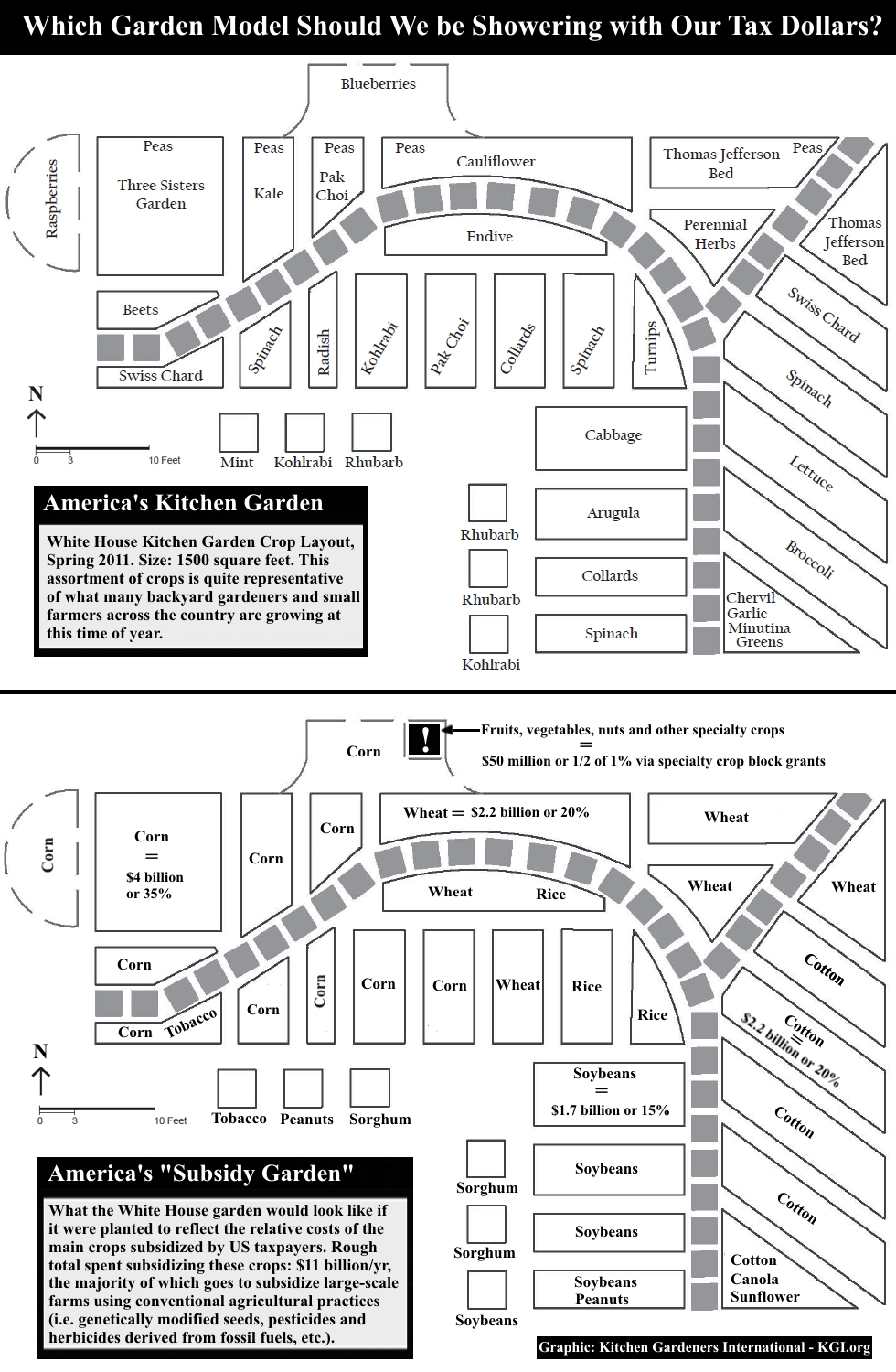
I stumbled across this graphic of the problem with American agriculture and nutrition. (Click the picture to make it bigger once you get there.) The top part of the picture is a graphic of the layout of the White House vegetable garden, growing all of the delicious vegetables that are commonly grown by home gardeners across the land: herbs, leafy greens, cruciferous veggies like broccoli and cauliflower, and so forth.

The bottom part shows what the White House garden would look like if it accurately reflected the percentages of food crops grown by farmers nationwide, mostly as a result of billions of dollars in farm subsidies. It's... not really very appetizing. Not unless you want to only eat corn, wheat, soybeans, cotton, and tobacco, anyway. Blech.

Just goes to show, U.S. agricultural policy has very little to do with producing food that is healthy for its citizens, and quite a lot to do with money and lobbying groups.

Thursday, June 2, 2011

A Look Back Through Time

1943_food_groups

The government knows what's best when it comes to our nutrition, right? Well, here's what they wanted us to eat back in 1943, during World War II. Check out the crazy categories, like butter and margarine forming their own food group. I've gotta say, though, this is actually far more balanced than the ridiculous, starch-heavy food pyramid.


Healthy eating guidelines are just that-- guidelines-- but if you think that what the government says about nutrition is set in stone somewhere, well... here's proof that it's not.

Elite Athletes Seek Nutritional Edge

1015486_52358247

How does 38-year-old NBA star Grant Hill stay so healthy that he's only missed three games in three years? Nutrition, apparently.

"I'm of the mind-set that food can heal," Hill said. "If we wanted, we could eat anything we want and still look in shape because we burn so many calories and because we're always running around. But this is about how you feel. And at the end of this past season, I felt great. I wasn't sore at all. I was ready to do things like climb Camelback."

Asked to summarize his own nutrition plan, Hill said simply:

"If it was around 50,000 years ago, I'll eat it."

Sounds like the paleo diet to me!